
Where’s Waldo?

There He Is!
Remember those “Where’s Waldo?” books? A busy beach scene, hundreds of tiny characters, and somewhere in the chaos a little guy in a red-and-white striped shirt. Your eyes scan, your brain filters, and eventually, you spot him. To you, it feels effortless.
Now imagine asking a computer to do the same thing, across a million pictures, overnight. Until fairly recently, that was a genuinely difficult problem. Today, thanks to a rapidly maturing field called machine vision, it’s a capability any business can leverage. And the practical applications go far beyond childhood puzzle books.
What Is Machine Vision, Really?
Machine vision is the branch of artificial intelligence that teaches computers to look at an image and understand what’s inside it. It doesn’t just see a grid of colored pixels; it recognizes concepts. It can look at a photo and conclude, “That’s a dog,” “This invoice is missing a signature,” or “That manufactured part has a scratch.”
The key word here is learn. Nobody sits down and writes a rigid software rule like “Waldo = red stripes + round glasses + goofy hat.” Instead, developers show the computer thousands of examples of Waldo (and thousands of examples that aren’t Waldo). Over time, the system figures out the visual fingerprint on its own. The more examples it sees, the sharper its eye gets.
This represents a massive shift from how computers used to “look” at the world.

The Old Way: Reading Instead of Seeing
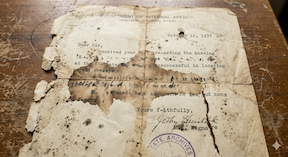
For a long time, if you wanted a computer to pull information out of a picture, the go-to trick was Optical Character Recognition (OCR). OCR tries to extract text from an image and then search that text for whatever you’re after.
OCR is genuinely useful. It’s how your phone copies a number from a physical business card. But it has a massive blind spot: it only understands text. Ask it to find Waldo and it fails, because Waldo isn’t a word. Ask it to tell you whether a scanned ID card looks legitimate, and it can read the name, but it can’t tell you if the photo layout looks forged.
Even when you are hunting for text, OCR easily gets tripped up by messy, real-world conditions. A slightly blurry “1” gets misread as an “l”. A watermark confuses the letter spacing. The computer tries to turn a rich, meaningful image into a flat list of letters, throwing away vital context in the process.
The New Way: Teaching Computers to See Shapes
Modern machine vision skips the reading step entirely. Instead of converting images into text, it learns what things actually look like.
Think about how you spot Waldo. You aren’t reading anything; you’re picking up on a cluster of visual cues: a specific pattern of stripes, the shape of a hat, the general silhouette of a person. A well-trained vision model does the exact same thing, just exponentially faster and at an industrial scale.
Under the hood, these models are built from layers of pattern detectors. Early layers notice basic edges and colors. Middle layers combine those into shapes and textures. The deepest layers recognize whole concepts—like a “face,” a “barcode,” or a “signature.”
The best news for business leaders? You don’t have to build any of this from scratch. The hard science is already baked into tools that software teams can pick up off the shelf.

The Developer’s Toolbox
If a development team tackled a machine vision project for your business today, they wouldn’t be reinventing the wheel. They’d reach for established, powerful tools:
• Pre-trained “Brains”: Tech giants have already trained massive vision models on billions of everyday images. A development team can take one of these existing models and fine-tune it for your specific problem whether that’s finding Waldo or spotting defects on an assembly line.
• Cloud Vision Services: Platforms from Amazon, Google, and Microsoft allow applications to pass an image to the cloud and instantly get back a list of objects, faces, or text found inside it. This is highly cost-effective for common, everyday image scanning.
• Open-Source Heavyweights: For highly customized, unique business problems, developers use battle-tested frameworks (like Python’s PyTorch or TensorFlow) to build and train bespoke models from the ground up.
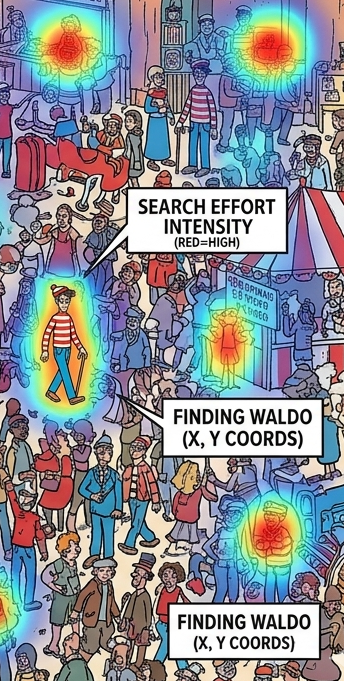
• “Explainability” Heatmaps: When an AI makes a decision, you often need to know why. Developers use specialized tools to paint heat-maps over an image, showing exactly which pixels the computer focused on. If your “Waldo detector” is actually just keying in on beach umbrellas, a heat-map will reveal that flaw in seconds so it can be fixed.
Where Machine Vision Shows Up
Once you understand the premise, you realize these “find something hidden in an image” problems are everywhere in the business world:
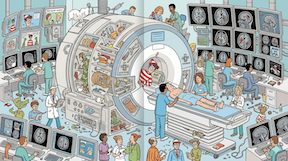
• Healthcare: Spotting early signs of anomalies in X-rays and MRIs.
• Manufacturing: Catching tiny, millimeter-sized defects on a fast-moving assembly line that a human eye would miss after a long shift.
• Retail: Analyzing a single photo to determine if store shelves are properly stocked.
• Document Processing: Automatically pulling key data fields out of invoices, contracts, and forms even when every vendor uses a totally different layout.
• Agriculture: Identifying crop stress or disease from drone footage before it can spread.
Different pictures, different Waldos but the same basic idea. There is valuable information hiding in plain sight, and a well-trained model can extract it consistently, around the clock.
A Few Honest Caveats
Machine vision is powerful, but it isn’t magic.
A model is only as good as the examples it learned from. If the training data is small, biased, or sloppy, the results will reflect that. Models can also be confidently wrong in bizarre ways like mistaking a blueberry muffin for a chihuahua. Finally, privacy and consent are vital concerns anytime a camera is pointed at real people.
But those caveats shouldn’t keep you away. It simply means you should treat machine vision like any other powerful piece of enterprise technology: understand the trade-offs, keep a human in the loop for high-stakes decisions, and start with a focused, small-scale pilot before you roll it out company-wide.
The Takeaway
If there is something hiding inside your business’s images such as a defect, a vital document field, or just a little guy in a striped shirt, the old instinct was to try to read the image. Today, the better business instinct is to let the computer see it.
Machine vision has quietly crossed the line from “cutting-edge academic research” to “a practical tool your business can actually use.” If you’ve got a Waldo-shaped problem slowing down your operations, it might be time to start looking for a visual solution
If you have any questions about this post please contact us today so we can help you figure out how to stay ahead of the curve.



 10400 Connecticut Ave #411
Kensington, MD 20895
10400 Connecticut Ave #411
Kensington, MD 20895